
The Ultimate Guide to ChatGPT for Product Management: Frameworks, Prompts, and Real-World Examples

Artificial Intelligence is fundamentally changing how products are built and managed. For Product Managers, Product Owners, and Strategists, ChatGPT is no longer just a chatbot; it is a vital tool for ideation, strategy, and planning.
Drawing insights from the course “ChatGPT for Product Management” by Enterprise Agile Coach Vipesh Singla, this comprehensive guide will teach you how to unlock the full potential of AI. You will learn the exact prompting frameworks required to generate professional product deliverables effortlessly.

Table of contents
1. The Universal ChatGPT Prompting Framework
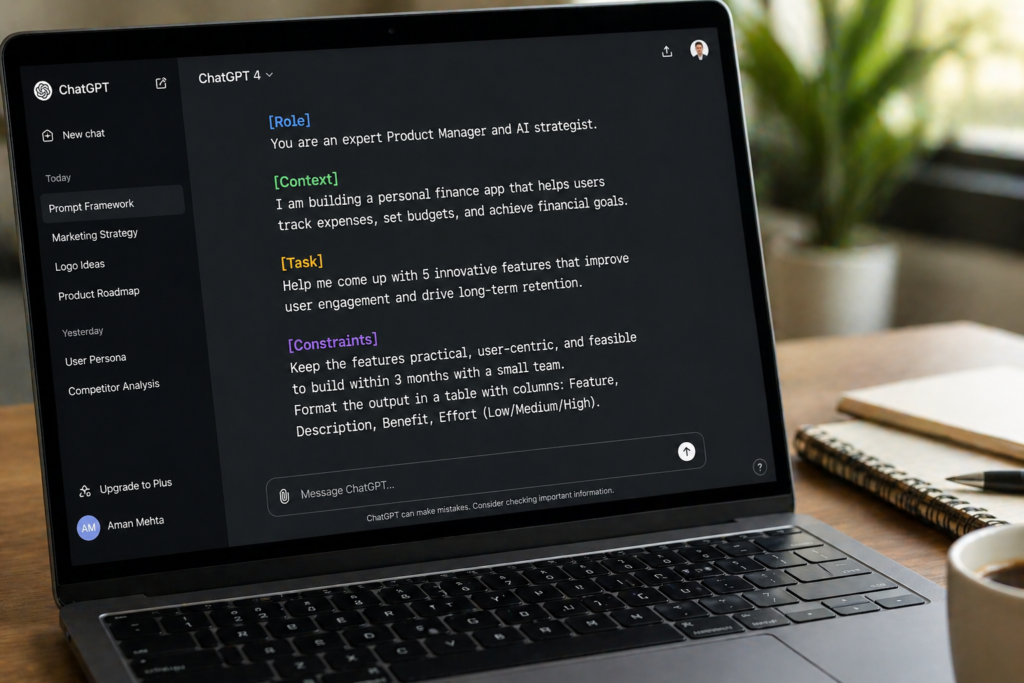
To get high-quality, professional results from ChatGPT, you must move beyond basic questions. Using a structured framework ensures the AI understands its exact role and constraints.
According to the established general prompt structure template, your prompt should always include the following elements :
- Role:
Assume you are a <Role/ Actor Name>, - Context:
for a < Describe the Product/Project >. - Task:
Generate the following sections: < Framework Sections Names >, - Framework:
for <Framework/Deliverable Name>, - Author:
by <Framework author name>, - Constraints:
<any other additional information>(e.g., “write in points” or word count limits) .
By explicitly naming industry-standard framework authors, search engines and AI models immediately recognize your intent to generate expert-level strategic content.
2. Creating a Product Vision Board with ChatGPT
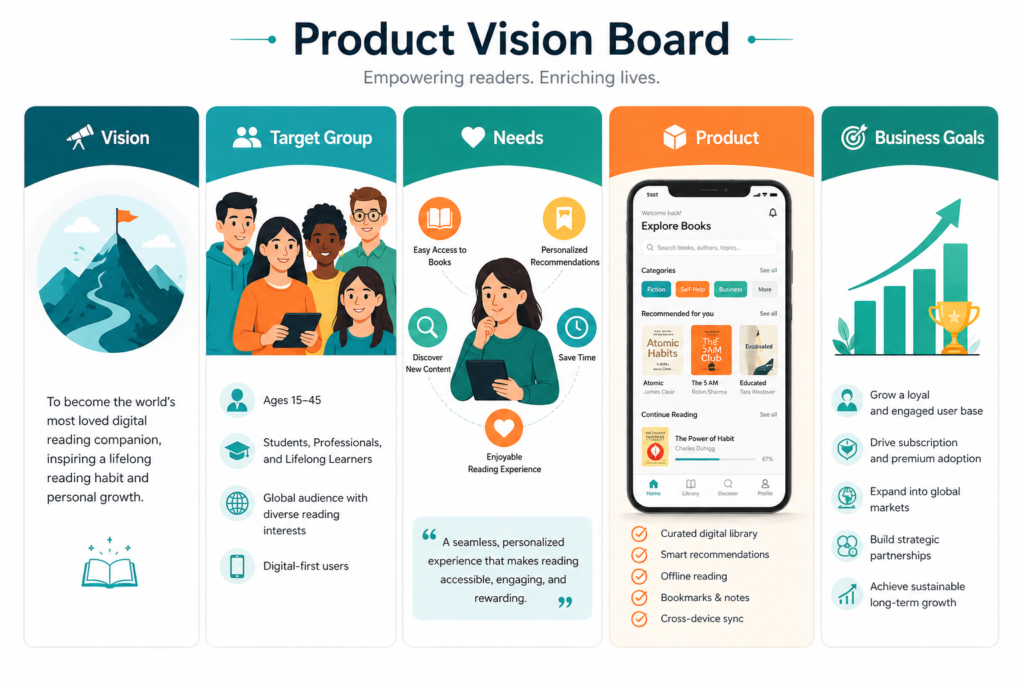
A Product Vision Board helps teams align on the “Why,” “Who,” and “What” of a product.
The Framework
Created by Roman Pichler, this board consists of five critical sections:
- Vision: What is your motivation for creating the product?
- Target Group: Which market or market segment does the product address?
- Needs: What problem does the product solve?
- Product: What product is it, and what makes it stand out?
- Business Goals: How is the product going to benefit the company?
The ChatGPT Prompt
If you are building an Amazon-style book-selling website (e.g., “BookPeople”), use this exact prompt:
"Assume you are a Product Manager, for a Amazon style Book selling website. Generate the following sections: Vision, Target Group, Need, Product and Goal, for Product Vision Board, by Roman Pichler, for this Amazon style Book selling website. Target Group, Need, Product and Goal sections should be written in points. Vision section should not be more than 40 words."
The Output
The AI will generate highly specific strategic points. For example, under Target Group, it will identify “Avid Readers,” “Students and Academics,” and “Gift Shoppers”. Under Business Goals, it will outline objectives like “Achieve 98% Customer Satisfaction Rate”.
3. Designing a Business Model Canvas (BMC)
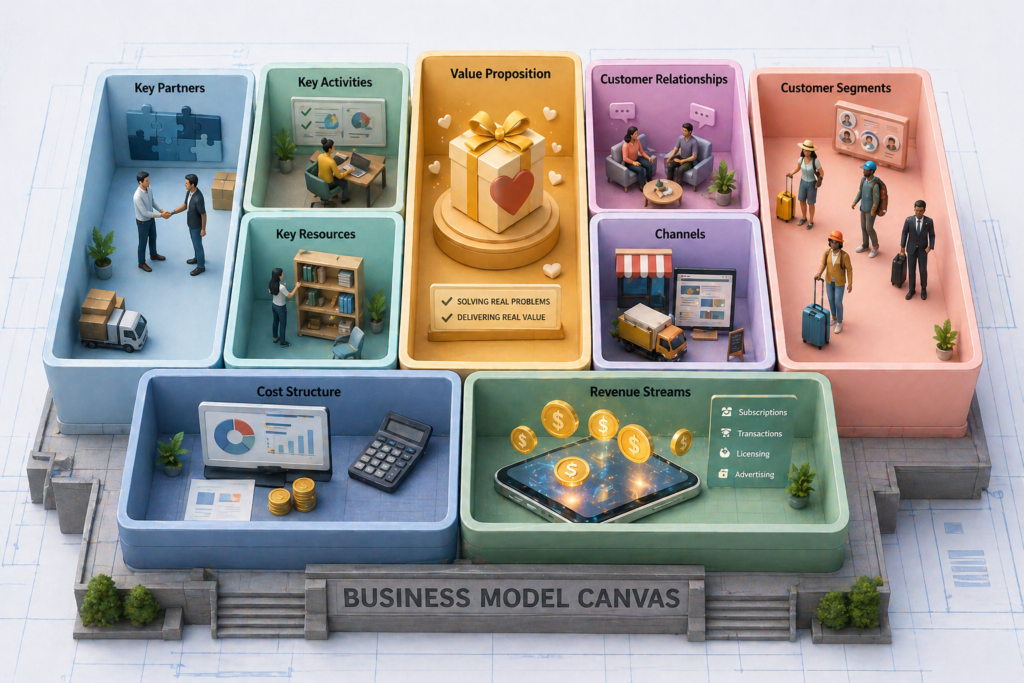
The Business Model Canvas is the ultimate tool for mapping out how your business creates, delivers, and captures value.
The Framework
Created by Alex Osterwalder, the BMC consists of 9 building blocks:
- Key Partners: Who are the key partners?
- Key Activities: What are the activities you perform every day to deliver your value proposition?
- Key Resources: What are the resources you need?
- Value Proposition: What is the value you deliver to your customer?
- Customer Relationships: What relationship does each customer segment expect?
- Channels: How do your customer segments want to be reached?
- Customer Segments: Who are your customers?
- Cost Structures: What are the important costs you incur to deliver the value proposition?
- Revenue Streams: How do customers reward you for the value you provide to them?
The ChatGPT Prompt
"Assume you are a Product Manager, for a Amazon style Book selling website. Generate the following sections: Customer Segments, Value Propositions, Channels, Customer Relationships, Revenue Streams, Key Resources, Key Activities, Key Partnerships and Cost Structure. for Business Model Canvas, by Alex Osterwalder... All sections should be written in points."
The Output (Airbnb Example)
If applied to an Airbnb-style platform, ChatGPT accurately identifies Key Partners as Hosts (Property Owners) and Payment Processors, and defines Revenue Streams as Service Fees and Host Commission Fees.
4. Feature Prioritization with the Kano Model
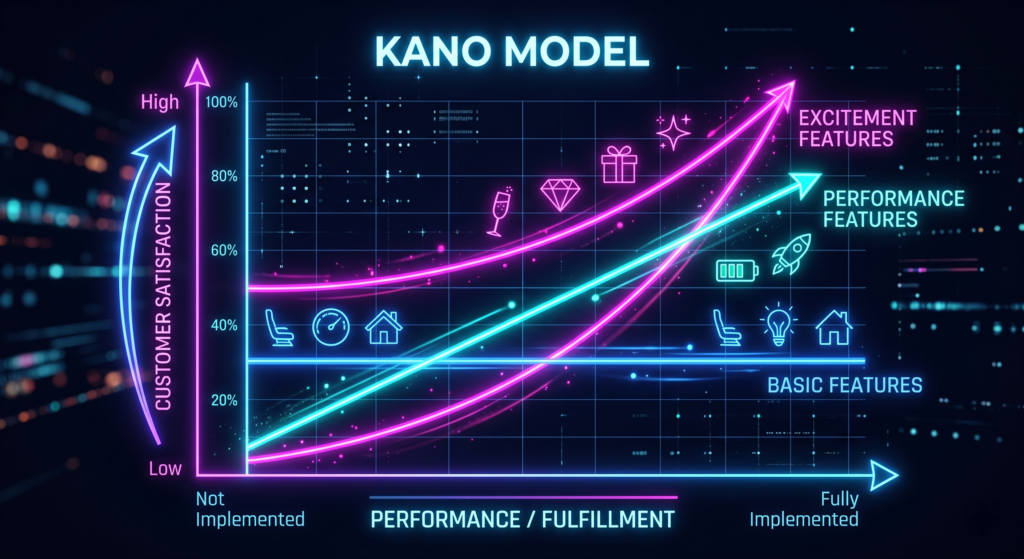
Deciding which features to build next is a major challenge for Product Managers. The Kano Model categorizes features based on how they impact customer satisfaction.
The Framework
Developed by Dr. Noriaki Kano, features are divided into three categories:
- Basic Features: Fundamental necessities; expected, minimal impact on satisfaction.
- Performance Features: Directly proportional impact; enhances satisfaction.
- Excitement Features: Unexpected delights that generate high satisfaction.
The ChatGPT Prompt
To evaluate features for a Ryanair-style airline (e.g., “SingAir”), use this prompt:
"Assume you are a Product Manager, for a Ryanair style Airline. Generate the following sections: Basic features, Excitement features and Performance features for Kano Model, by Dr. Noriaki Kano, for this Ryanair style Airline. All sections should be written in points."
The Output
ChatGPT will prioritize features intelligently:
- Basic: Low-Cost Fares, Online Booking, and Check-In.
- Performance: Reliable Customer Service, Fuel-Efficient Fleet.
- Excitement: Customizable Ancillary Services, Themed Travel Experiences.

Frequently Asked Questions (FAQ)
No previous ChatGPT knowledge or experience is needed [cite: -]. The tools rely entirely on natural language prompting.
No. ChatGPT acts as an intelligent assistant to accelerate the drafting of deliverables like the Business Model Canvas and Product Vision Board. The Product Manager is still required to review, refine, and execute the strategy.
Naming the author (e.g., Roman Pichler or Alex Osterwalder) gives the AI strict boundaries and context. It ensures the output strictly follows the official structure of the requested framework rather than generating generic advice.
Always use the “Review/Refine” step. Generate a sample deliverable using the prompting framework, and then actively review and refine the AI’s output to ensure it aligns perfectly with your specific market reality.