

If you’ve been scrolling through tech news lately, the headlines look like a script from a dystopian sci-fi movie.
Leaders at the top of the AI food chain—like Microsoft’s Mustafa Suleyman and Anthropic’s Dario Amodei—have been warning that white-collar office jobs could “crumble” or be cut in half within the next 18 months. Even the Federal Reserve has noted that the job market is feeling the “quiet” pressure of automation.
But according to a new report from the National Bureau of Economic Research, the people actually signing the paychecks—the CFOs—have a much more grounded (and slightly more optimistic) perspective.

The Reality Check: By the Numbers
While AI-related job cuts are undeniably accelerating, they aren’t hitting the “doomsday” levels predicted by Silicon Valley’s loudest voices. Here is the breakdown of what 750 U.S. CFOs are actually planning for 2026:
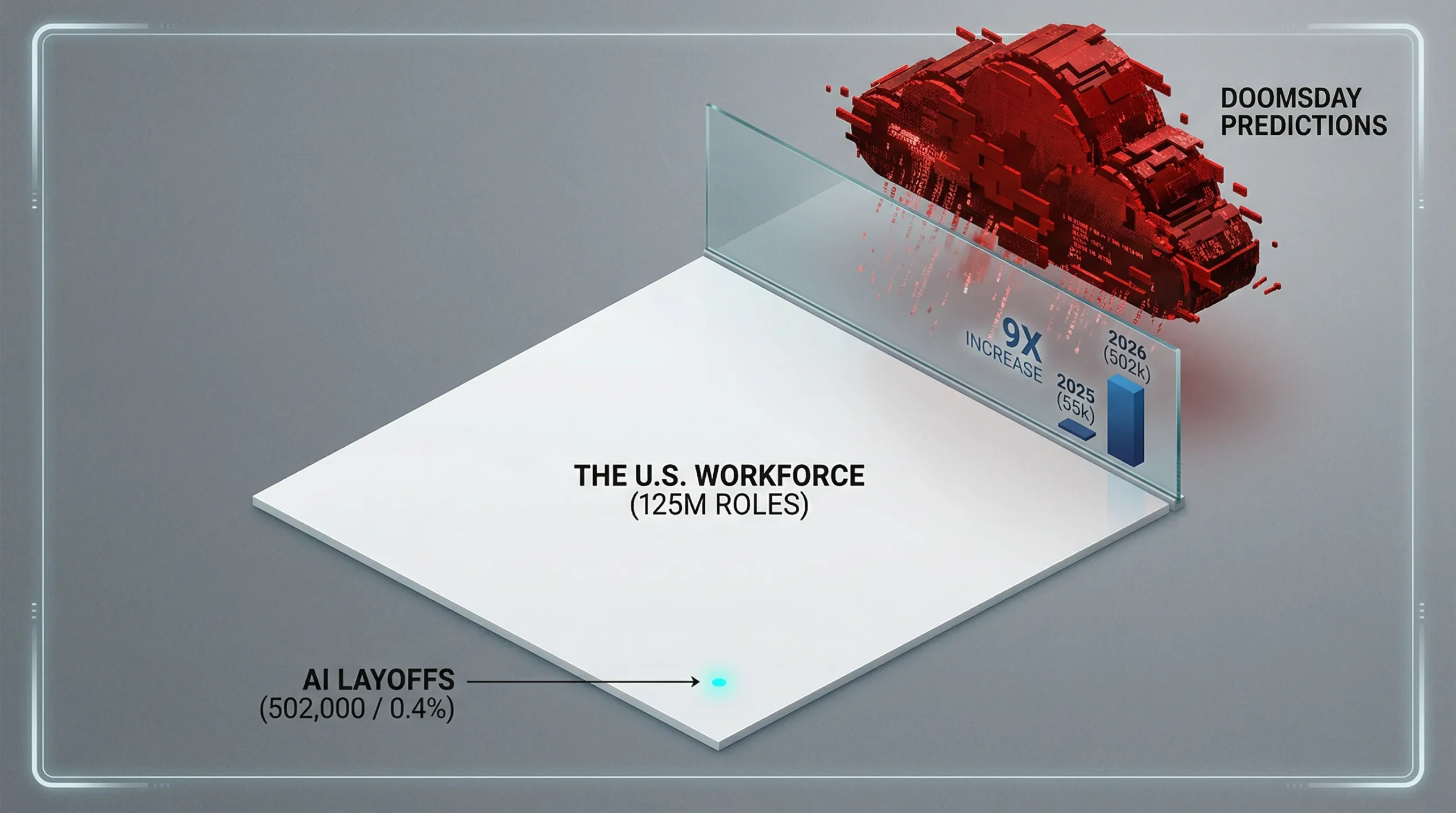
- The Surge: AI-attributed layoffs are expected to be 9x higher than last year.
- The Total: Roughly 502,000 roles are expected to be lost this year.
- The Context: While 500k sounds massive, it represents only 0.4% of the 125 million roles in the U.S. workforce.
- The Strategy: Only 44% of CFOs surveyed plan to make AI-related cuts at all.
As John Graham, director of the Duke CFO survey, puts it: “It’s not the doomsday job scenario that you might sometimes see in the headlines.” For now, these losses are essentially a “rounding error” in the grand scheme of the global economy.
The “Productivity Paradox”: Why Everyone Isn’t Fired Yet
If AI is so revolutionary, why aren’t companies replacing everyone immediately? The answer lies in something economists call Solow’s Paradox.
Back in 1987, Nobel Laureate Robert Solow famously said, “You can see the computer age everywhere but in the productivity statistics.” We are seeing a repeat of that today. Companies are investing billions into AI, but the “cool things” the tech can do haven’t translated into actual revenue or massive time savings yet.
In fact, some data suggests AI is currently making us less productive.
Workers have reported that some job responsibilities now take up to 346% longer as they struggle to integrate AI tools into messy, human workflows.
CFOs are realizing that until the “perceived” gains of AI become “actual” gains, they still need human hands at the wheel.

Where the Cuts Are (and Aren’t) Happening
The pain isn’t being felt equally across the board. We are seeing a “barbell” effect in the 2026 labor market:
1. Big Tech is Slimming Down
Larger firms are the ones pulling the trigger on layoffs to appease investors and pivot toward AI-centric models.
- Block (Jack Dorsey): Cut roughly 40% of its workforce (4,000+ employees).
- Atlassian: Cut 10% of staff.
- Meta: Rumored to be planning a 20% reduction as Mark Zuckerberg focuses on “AI agents.”
2. Small Businesses are Hiring
In a surprising twist, firms with fewer than 500 employees are actually increasing their hiring. As these smaller companies adopt AI, they find they need more technical talent to manage the transition, which is helping to offset the losses seen at the giant corporations.
The Bottom Line
We are currently in a “lag” phase. The 4.4% unemployment rate and the 92,000 job losses reported last month show the market is in a lull, but the “AI Apocalypse” hasn’t arrived.
For the average worker, the message from the C-suite is clear: AI is changing the way work gets done, but it hasn’t replaced the worker. While 2026 will see a significant jump in layoffs compared to 2025, the transition is proving to be a slow evolution rather than a sudden collapse.
As for what happens in 2028 or 2030? Even the experts admit that’s anyone’s guess. But for now, the “doomsday” clock has been pushed back.
Is your workplace starting to feel the “AI lag,” or are you seeing these tools actually speed things up?
Conclusion
Frequently Asked Questions: AI & The 2026 Job Market
No. While the 9x increase in AI-related layoffs sounds alarming, the data shows these cuts represent only 0.4% of the total U.S. workforce. Most companies (56%) have no plans for AI-related layoffs this year, and many smaller firms are actually increasing hiring for technical roles to help manage AI integration.
This is known as Solow’s Paradox. Many CFOs are making “preemptive” cuts to stay competitive or to offset the massive costs of AI investment. However, because AI currently requires significant human oversight and creates extra “review cycles,” actual revenue gains are lagging behind the initial hype.
The 2026 trend shows that entry-level white-collar roles (such as data entry, basic administrative tasks, and junior content creation) are the most vulnerable. Conversely, high-skill roles that require strategic decision-making and low-skill manual trades remain highly secure, as AI still struggles with complex human nuance and physical dexterity.
It’s a “mixed bag.” While AI can draft reports in seconds, workers report that the overall workflow has become more complex. Time spent on “fact-checking” AI hallucinations and managing fragmented digital tools has increased by up to 346% in some sectors, leading to a temporary “productivity dip” before the long-term gains kick in.
The best defense is “Human-Centric Upskilling.” Focus on roles that require emotional intelligence, complex problem-solving, and “Goal Engineering”—learning how to direct AI to achieve specific business outcomes rather than just performing repetitive tasks.